Showing posts with label poem. Show all posts

Monday, June 29, 2015

In the Grass

It was one of those perfect summer days I've written about so many times before. The sky was bright and blue and all the clouds were relegated to standing guard on the periphery, rising above the mountains or far out over the eastern plains but well away from any place Duncan and I might venture on our afternoon walk. There was a breeze, warm, but pleasant on my arms and the back of my neck, carrying with it the last of the perfume from the Russian Olives. But even better, down by the small misplaced pond, shrouded in tall pussy willows and awkward, gangly cattails, a sandhill crane was wading through the murky shallows, its spindly legs thrusting in and out of the water as it's long beak darted in, poking for minnows and frogs among the moss and mud. The cottonwoods, standing their regal watch, have started doing that thing they do best: releasing clouds and clouds of downy snow that drift lazily in the golden afternoon among the gnats and other tiny flying things. It is my favorite time of year, before the sun has bleached the depth of color from the world and turned the earth to bone. So I stood a long moment on the path while Duncan sniffed the tall grass beside me, his head vanishing for minutes at a time among the thick, damp blades. He was in search of something, but then so was I.


On afternoons like this I think of Mary Oliver, my favorite poet, and all the words she has arranged that so perfectly capture the feelings these moments arouse in me. And that is what poetry is or should be--a snapshot of a moment, a thought, a feeling, something that can be expressed in no other worldly way outside of the experience.

I don't know exactly what a prayer is.
I do know how to pay attention, how to fall down
into the grass, how to kneel down in the grass,
how to be idle and blessed, how to stroll through the fields,
which is what I have been doing all day.
Tell me, what else should I have done?

And at that moment, when the trees were raining their cotton down so perfectly, the insects dancing around and among it, when the bird chorus fell into perfect syncopation, when the crane spread its wings and took to the air--perilously low at first, its breast cutting the tiniest of ripples along the surface of the pond before it gained its strength and launched heavenward over the willows--when Mary Oliver's words were lining up on my lips and tongue, Duncan lifted his head--his beautiful, red head, outlined in the loveliest of amber summer light--trotted out of the grass toward me, and dropped a thick, green, and very dead snake on my foot, the smile wide and glorious on his face.

Moments are precious to each of us, in their unique way. Right? That's what I tried to tell myself as I sucked all the air out of the known world into my lungs, did one of those allover body trembles, and danced away as quickly as I could.


If you liked this post, please feel free to leave a comment. They're always appreciated.

Saturday, May 18, 2013

A Scourge of Seeds

When I Am Among the Trees

When I am among the trees,
especially the willows and the honey locust,
equally the beech, the oaks and the pines,
they give off such hints of gladness.
I would almost say that they save me, and daily.

I am so distant from the hope of myself,
in which I have goodness, and discernment,
and never hurry through the world
     but walk slowly, and bow often.

Around me the trees stir in their leaves
and call out, "Stay awhile."
The light flows from their branches.

And they call again, "It's simple," they say,
"and you too have come
into the world to do this, to go easy, to be filled
with light, and to shine."  
(Mary Oliver)


There are few things more wondrous than a tree in Springtime, when it seems to move without moving, to grow and change in the span of an eye-blink. They are living statues, rejoicing so obviously under the tender ministrations and delicate kisses of the new sun. They speak a language only understood by the birds and flowers and insects, and yet one needs only gaze upon them and listen for a few moments to learn the melody they sing so surely with their silent voices. While Duncan tends to walk with his nose and eyes to the ground, my gaze is pointed up, at the dancing tendrils of the willows, at the slowly blooming Russian Olives, at the Linden outside my window that will transform entirely my apartment in a few short weeks. I am in awe of the trees––all trees!––even the scourge of Narrow Leaf Cottonwoods that plague my small corner of the world.

I do not hate them. These cottonwoods, different than the more common Eastern Cottonwood that most people easily recognize, are wonders of Summer, reflecting the light in a way that freckles the world in gold and shade and dancing green shadows, cooling The Run on our afternoon walks. They are never still, even when the air is, and the sound of their leaves brushing against each other are as sweet as the soft twinkling of the chimes that grace my patio. They don't grow as tall as their eastern cousin, and their cotton is fine and beautiful and something I marvel at and don't mind at all. In Autumn they are magnificent, their voices loud, their presence soothing as the leaves turn pale yellow and then fall away where they can dance wild and run in the wind. They are the sentinels of winter, standing guard over the park and The Glen, their pale, rough bark catching the snow and holding it close like a drapery of loose gauze. It is only in Spring that they are a challenge.

It's their seeds I loathe. They are everywhere, impossible to avoid: lurking among the tall grass, polluting the sidewalks as thickly as the spattering of goose-droppings we dodge in winter. They are thorough in their infection of both The Glen and the park. Long and yellow, the seeds are covered in a thick and sickeningly sweet resin that catch the hair of Duncan's feet and collect into a sticky clot under his soft pads. Dunc spends much of our walks laying down to nibble at his feet, pulling on them, tearing the fur from his feet and then sputtering to spit them away before they catch in his whiskers and collect along his muzzle. And once he's done, his belly is covered in the things, which, if left untended, turn into twisted mats that need to be cut away. They are miserable, contagious things and I look forward to the day they have dried up and been carried away by the wind.


They are a nuisance, but only temporarily. In a few weeks they will be gone and the trees where they originated will be more glorious than before. Until that day, though, when they snow magic and bring a warm winter, Duncan and I will tread carefully and await the return of our Lindens and glorious-scented Russian Olives.

Thursday, April 4, 2013

This Happened Today

When I Am Among the Trees


When I am among the trees,
especially the willows and the honey locust,
equally the beech, the oaks and the pines,
they give off such hints of gladness,
I would almost say that they save me, and daily.


I am so distant from the hope of myself,
in which I have goodness, and discernment,
and never hurry through the world
but walk slowly, and bow often.


Around me the trees stir in their leaves
and call out, "Stay awhile."
The light flows from their branches.


And they call again, "It's simple," they say,
"and you too have come
into the world to do this, to go easy, to be filled
with light, and to shine."
(Mary Oliver)


My eyes are quick for Spring, for the first glimmer of green under a mess of snow or concealed by the devastation of last season's once-leaves, and as April quickens I feel my eyes hunting for and preying on the newness of the world. The grass has made a valiant effort, slowly shaking aside its matted coat of brown and yellow, cautiously slipping into something more comfortable, brighter, flirtatious even. But I am impatient and the grass has not been enough. While Duncan and I have walked my gaze has prowled the uppermost branches, the highest beacons of the trees for the first glimmer of green and today, as Ken walked with Duncan at his side, I strolled slowly behind, examining each limb and finger, combing every inch of the maples and willows, the ash and cottonwoods, like I comb Duncan for ticks after a romp up my mother's mountain, my eyes hungry for a bud broken and shattered by the first swelling of an unfurling leaf.

And then, after leaving the park and turning back toward home, after stopping to check the mail and dispose of the relentless flow of coupons and junk, I saw it, a single tree, the sky bluer than blue above it, calmly but certainly bursting with buds. So I stopped and marveled as I do every year at this time, gazing as though I have never seen such a thing, as though winter had been thirty years long and green was something not witnessed since childhood. And I didn't feel foolish because this should be the only way to look at the newness of spring, of the coming of the leaves, of the blessed change of season. This should be law and the penalty should be severe for anyone who does not pause and give thanks.


Forty-two times I have lost my virginity to spring and if The Universe is willing, I will lose it forty-two times more. 

This happened today. 

Wednesday, September 5, 2012

Gratitude

It was five years ago tonight I gave up my previous, short-lived fiction blog, took Duncan for a walk and thought, "Hmmmm. What if....."

An hour or so later, thanks to a little boy who couldn't wait, While Walking Duncan was born.


Eight-hundred seventy-one posts, forty-thousand plus page-views, and countless feathers later I'm still going strong. Readers have come and gone and come again but every day Duncan and I walk. It's what we do.

Thank you not only for tagging along but for the support and encouragement you've offered over the past five years. My life has been forever changed by your presence in it.

If you'll allow me to share another poem from Mary Oliver, who seems to know exactly how I feel every moment of my life, I'd be most grateful.

Gratitude


What did you notice?

The dew snail;
the low-flying sparrow;
the bat, on the wind, in the dark;
big-chested geese, in the V of sleekest performance;
the soft toad, patient in the hot sand;
the sweet-hungry ants;
the uproar of mice in the empty house;
the tin music of the cricket’s body;
the blouse of the goldenrod.
What did you hear?
The thrush greeting the morning;
the little bluebirds in their hot box;
the salty talk of the wren,
then the deep cup of the hour of silence.
What did you admire?
The oaks, letting down their dark and hairy fruit;
the carrot, rising in its elongated waist;
the onion, sheet after sheet, curved inward to the
    pale green wand;
at the end of summer the brassy dust, the almost liquid
    beauty of the flowers;
then the ferns, scrawned black by the frost.
What astonished you?
The swallows making their dip and turn over the water.
What would you like to see again?
My dog: her energy and exuberance, her willingness,
    her language beyond all nimbleness of tongue, her
    recklessness, her loyalty, her sweetness, her
    sturdy legs, her curled black lip, her snap.
What was most tender?
Queen Anne’s lace, with its parsnip root;
the everlasting in its bonnets of wool;
the kinks and turns of the tupelo’s body;
the tall, blank banks of sand;
the clam, clamped down.
What was most wonderful?
The sea, and its wide shoulders;
the sea and its triangles;
the sea lying back on its long athlete’s spine.
What did you think was happening?
The green breast of the hummingbird;
the eye of the pond;
the wet face of the lily;
the bright, puckered knee of the broken oak;
the red tulip of the fox’s mouth;
the up-swing, the down-pour, the frayed sleeve
  of the first snow—
so the gods shake us from our sleep.


Thank you from the bottom of my heart.

Sunday, July 15, 2012

A Right Way to Live

When I Am Among the Trees
When I am among the trees,
especially the willows and the honey locust,
equally the beech, the oaks and the pines,
they give off such hints of gladness,
I would almost say that they save me, and daily.
I am so distant from the hope of myself,
in which I have goodness, and discernment,
and never hurry through the world
but walk slowly, and bow often.
Around me the trees stir in their leaves
and call out, "Stay awhile."
The light flows from their branches.
And they call again, "It's simple," they say,
"and you too have come
into the world to do this, to go easy, to be filled
with light, and to shine."
(Mary Oliver)

There is a moment, late in a summer's day, not long before the sun sets, when the shadows have grown so long they are like a blanket pulled across the world, when the light through the trees is an overwhelming gold, so vibrant it can be felt, when the birdsong is softening and lulls the crickets and night creatures awake, urging them to join the chorus, when the tips of the tallest, flowering blades of grass catch the precious light among their budding tips and carry it proudly, like lanterns held aloft, that is my favorite time to take Duncan for a walk down The Run to The Glen.


The voice of the trees is a soothing whisper and the cool air rising up from the grass is as rejuvenating as lemonade. Neither of us is in a hurry, which is the best way to walk, and step softly around the brilliantly illuminated wings of the insects which rise up and dance around our ankles before settling down among the thick blades of grass as we pass. The traffic dies down long enough for dinner and the spin of the world seems to relax and stop so that the night is frozen, caught in amber, captured forever in my memory as another perfect evening, the kind I will walk through in dreams many times long days from now.

Surely there is a right way to live, and when I am with Duncan on nights such as this, I'm certain I have found it.

Sunday, October 23, 2011

The Tipping Point

Besides the autumn poets sing,
A few prosaic days
A little this side of the snow
And that side of the haze.
(Emily Dickinson
)

Duncan and I have spent two glorious afternoons wading ankle-deep among the leaves, their sound underfoot glorious and heart-breaking all at once, the fortune cookie voices they contained all summer finally given sound and reason as their bodies are broken by our passing steps. I have watched the colors change slowly, keeping my watchful eyes on the maples and cottonwoods, always the last to change. The elms, weak and without hope or courage, gave up their bounty in September, but the cottonwoods and maples have held true, their spirits more like mine––optimistic and full of dreams. But this morning I spotted their first changing, so I stood a long moment, plucking with my eyes, the soda can yellows sprouting among their lush canopy in much the same way I watch Ken stand at the mirror and pick out the very first graying hairs at his temples.


Two days of warm, windless afternoons and cool, pleasant evenings, the scents of burgers and chicken on the grills in direct defiance to the cold and snow that is coming, as early as Wednesday we are told. We have reached the tipping point and soon the color all around will be replaced with snow, exciting and bland all at once. Too soon there will be too few leaves on the trees and the wind will find our warmest spots, poking and prodding until it forces us back inside where it will howl curses of cowardice at us. I am not looking forward to it. As much as Autumn hurts my heart, Winter is even more difficult. Duncan will see me through it, though; his enthusiasm for the flakes and drifts and whitewash as tremendous as my love of the sun and sweat and Russian Olives.

Bless my good dog and his love of all things.

Friday, September 30, 2011

Music

I have never been a fan of Autumn. You can keep your layered clothes, your baggy sweaters, your crisp mornings and the far-away sky, your dying leaves and the blossoming bareness of the trees overhead, the stale, cool earthiness of the air when you breath. These things mean nothing to me.

I will say this, though: there is great delight to be found in stepping on the leaves, cracking their yellowing backs between your heel and the sidewalk, listening to the delicate melody of their shattering as your weight crushes them to dust. It is a percussion unmatched, except perhaps by heave and meaty slip of those late winter ice racks that gather along the edge of the sidewalks, shattering as you step across them. 

I do not like Autumn one bit, but I love my dog's place in it, especially the sound of him kicking up its wake as he moves forward, ever forward, his propeller tail stirring their air behind him, his smile and amazing eyes pulling him forward.


There is music to be found there. Duncan is its maestro and all I can do is learn to listen and try as hard as I can to allow his tune to carry me along.

Sunday, July 24, 2011

"The First Brights of Dawn"

There was a time I wrote poetry. I was younger then, and more optimistic, with eyes and a heart a little more open to the world and the wonders concealed there, quiet but visible and willing to be found with only the slightest of effort. I fell in love with poetry in college, casting aside bad, angst-riddled, self-consumed verse written late at night in coffee shops, surrounded by drunks and sad-smelling, grounded truck drivers in favor of more serious work, educated and with a sincere appreciation for the specifics world.

It has been a long time since I have written a poem but lately I have been listening to a great deal of them, purchasing audiobooks of poets reading their own works in voices that hold complete command of the turning of a line and the cadence of words, holding them like one holds a small bird openly in the palm of your hand, with a selfish desire to keep it––this precious, vibrant warmth––for yourself while wanting nothing more than to feel and see it pull itself forward into empty space, pausing a moment to taste gravity before defying it and leaping into the void. I listen to poems in rapt silence, each word stirring me, making me marvel at the poet's choice in the much the same way I marvel at clouds or the blackened silhouettes of mountains outlined by bursts of nighttime lightning. I hang and hold my breath and wonder at the talent and magic of such folk and wish only to walk with them through the worlds they inhabit, where things are more than them seem, infused with what they are and more importantly, with what they are not, so that they become real, as tangible and solid as a river stone, slippery but secure all at once.

I was listening to Mary Oliver last night, her voice worn and softened with age, brittle at the edges but comforting in its command and her confidence with the experience of all those walks she has taken through the wilds of her world. And then this morning, with Duncan in the early hours of this day, feeling his still-sleepy weight against my calf as we walked across the street to the tame green of the park, the bodies of the trees painted a safe red with the delicate brush of dawn, I wondered if the poet I yearned to be had died or was laying dormant somewhere in me, asleep and waiting, safe but impatient in the silence. I listened to the doves hidden among the mourning drape of the willow vines and inhaled the newness of this day and wondered what the poet in me could possibly say about them and why he hadn't spoken up.

And then Duncan tugged and looked up at me, eyebrows raised in silent question. I removed his leash and watched him pull loose of his tether, to gallop across the grass and thrust his face into its damp delight, skewing the soft hair––bed-rumpled and wild––of his long ears. My heart burst at the sight of his thoughtless joy, his disregard for what could have been and perhaps should have been. This moment was his and mine I suppose, too, for standing witness to it. And I no longer cared that I was not writing poems because Duncan has taught me how to live them.

Trying to Be Thoughtful in the First Brights of Dawn
 
I am thinking, or trying to think, about all the
imponderables for which we have
no answers, yet endless interest all the
range of our lives, and it's
 
good for the head no doubt to undertake such
meditation; Mystery, after all,
is God's other name, and deserves our
 
consideration surely.  But, but -
excuse me now, please; it's morning, heavenly bright,
and my irrepressible heart begs me to hurry on
into the next exquisite moment.
(Mary Oliver)


Saturday, July 16, 2011

Deep Summer

It thundered again this afternoon while Duncan and I slept on the couch, the blinds drawn, cocooning us in, the fan turning softly and humming a sweet low note that somehow made the trembling of the dark outside less menacing, something felt rather than heard, the day's pulse. When we pulled ourselves from our afternoon dreams, which are sweet and rich and difficult to shake away, the storm had moved on, leaving a great, vast blue swathe between it and the next line of low, mottled clouds. We ventured out, enjoying the wet our feet kicked up from the dampened grass, the pearly drip of the rain's remnants from the ash and maple and elms in our path, the slow-to-rouse song of the birds rising cautiously from their shadowy hiding spots. Duncan led me to the park, to a place where, if you stand in the right spot, you are are afforded a view of the green hillside rising above you and the setting sun and the mountains below it, without the clutter of the strip malls or the ill harmonies of the traffic congesting the roads beyond. It is a quiet place––a listening place––where you can look out over the freshly trimmed baseball fields and the eastern sky or you can hush yourself and watch the new bunnies explore the tall clover while their mothers stand guard and the crows in the bone branches of the aspens warn of our presence.


We spread ourselves out on the moist grass, cool on my back, and watched our blue swathe drift ever so slowly south, chasing a storm while another chased it. The air turned golden for a moment and was sweet in our mouths. Silence descended as the evening's storm moved in and the tiniest drops began to patter on my arms and legs. Duncan lapped at the air with his tongue and turned his face away from the storm, looking calmly toward the south and east, a glow in his eye, peace in his posture. We stayed there a long time, watching the world be the world all around us, listening to the rapture of this quiet summer eve.

Listen, if you would listen.  There's no end to good talk, to passion songs,
to the melodies that say this branch, this tree is mine,
to the wholesome happiness of being alive on a patch
of this green earth in the deep pleasures of summer. ("Deep Summer," Mary Oliver)


Thursday, June 30, 2011

Long, Long Moments

Several years ago, when my little outpost on the internet was still somewhat new, when I was at the tail end of my first year of learning the seasons in this place where we'd moved––an education that persists to this day, as Duncan seems to lead me deeper and deeper into the more subtle nuances of our world––I discovered the Linden trees, which, while not a replacement for my Russian Olives, have become a unique and greatly anticipated part of my year. They have become a marker for the days I have spent in Littleton and are worth the distance I choose to live away from Denver. They are the things I will miss the most, should I ever choose to leave, nearly as precious to me as the fireflies I left behind in the Shire-like Midwest all those years ago.

They are everywhere in Littleton and the air is just beginning to fill with the scent of them, a perfume that is as light and sweet at the Russian Olives are heady and sticky. It is tinged with traces of lilac and gardenia and candied plums, and does not saturate but wafts, like the settling balls of white which drift down from the tallest branches of the grand Cottonwoods. It is an odor that does not invade but waits for an invitation like a demure and blushing schoolgirl. There should be candles and perfumes built around it, and poems written about it, but sadly, the world is lacking in these things. So I must content myself with the brief weeks when I can sit on my patio, which looks out on four of them, and the one grows quite close to the window in my office so that when I sit at my desk and the breeze blows, as it is tonight, the sweet smell drifts over my face and soothes my spirit.


Duncan has been very patient with me these last few days, as the golden blossoms have opened up and exploded with the yellow bells of the flowers. They have pulled me to them and so we have stood beneath their shade for long, long moments, eyes closed, breathing them in, washing our pallet with them, dreaming of all the years of Lindens still to come. The passing of June could not be more sweet.

Away I walked for hours
whence stands the linden tree,
and still I hear it whisp'ring:
You'll find your peace with me!
(Wilhelm Müller, "Der LIndenbaum")

Monday, June 27, 2011

A Kind Rain

I don't know exactly what a prayer is.
I do know how to pay attention, how to fall down
into the grass, how to kneel in the grass,
how to be idle and blessed, how to stroll through the fields,
which is what I have been doing all day.
Tell me, what else should I have done? 
(The Summer Day, Mary Oliver)

It was a simple request Duncan made, tugging as he did on his leash and leaning far away from me, as horizontal to the grass as the physics of my grip on his leash would allow. The sky had darkened in many but not all places and a surprisingly cool summer rain was beginning to fall, its big drops making loud, almost obscene smacking sounds on the pavement around us, refusing to evaporate in the golden, early-evening light and scattering the diligence of the ants working there. Duncan tugged again and looked parkward, where the sky was considerably darker and the grass beneath it had turned a sort of menacing gray. North of us it was vast and blue and I knew if we waited only an hour we would miss the rain and return home for dinner unhurried and dry, content. But the imploring eyes and wishes of dogs are stronger than physics so I relented and let him lead me across the street, the big rain falling on my cheeks, running cold trails down my neck past the collar of my t-shirt where they slid onto my back.

It was a good rain, though, the kind where the sun has somehow managed to find itself trapped above the horizon but below the line of clouds and mountains, its last gold concentrated and sweet, radiant and crisp in the haze of rain. Duncan's tail and head were high and I found myself not minding the wet in my hair or the diamond glitter in my eyes. We walked through it, and ran occasionally, without self-consciousness or even the desire for shelter. And when it passed to the south and was gone, when the sun had returned and the sky blued before us once again, calmly and without show, we spread out on our bellies on the cool grass and played together, rolling and talking, both of us smiling, one of us chewing a stick the other watching the storm move away, the light receding after it.

Sometimes, when the day has been long and I am very tired, I reflect on my life before the obligation of a dog, before I was faced with the choice of staying dry or allowing the rain to soak my clothes, when my days were my own and I could come and go as I pleased, and I think, That life was so much simpler; what happened to it? But this one, this incredibly beautiful life I have chosen, is far richer and I would not trade it for anything.


There really is no choice to be made at all, is there.

Sunday, November 7, 2010

Red, then Gone

Yesterday, running through the park with Duncan, the two of us caught up in the heat and revelry that was the most incredible November day I can remember, we passed a glorious bush, bursting with red leaves, each of them catching the heavy golden rays of the late afternoon sun. It was like a heart, beating and filled with blood and lust and fire right there in the middle of the park, so bright and overwhelming it was almost obscene to look upon. We must have passed it a hundred times this Autumn but this time––at this instant––it exploded in our presence, as if it had lived its entire life for one brief moment, waiting for the eyes of a dreamer, someone who does not easily forget, to gaze upon it before it was swept away by the coming winter. 


We stopped and stood before it so I could reach out and touch the delicate brittling leaves, half afraid they would burn the tips of my fingers when I did so. They were still soft, though, like velvet, and I wished there was something I could do, take it home with me perhaps, something to preserve it exactly as it was.

But this weather and these colors cannot last. This afternoon, warm but windier than I would've liked, we crossed into the park when the sun was low in the sky, painting its rays above the mountains in clear streaks, and went back to the bush. I needed to see it one more time, to burn it onto my eyes and memory but the moment had passed. The wind had swept the leaves away, all but one, and the sun ignored it as it danced on the air and resisted the tug of the wind. Duncan stood by my side, leaned into me and the two of us held our breath until that one leaf relented, gave up its battle with the season and was finally swept free of its branch. It twirled once in the air, struck me in the chest and was whisked away forever.


What a difference a single day can make.

The long darkness is coming. Winter is nearly upon us and these walks with Roo in the daylight will be brief and rare. How I wish that bush would burn through all the cold walks ahead.

The one red leaf, the last of its clan, 

That dances as often as dance it can, 

Hanging so light, and hanging so high, 

On the topmost twig that looks up at the sky.

(Samuel Taylor Coleridge)

Monday, June 28, 2010

Wakeful Dreams

The clouds rolled in along the edges of the horizon tonight in lines, like row after row of white waves lapping against the idyllic, sandy rim of a tranquil lagoon. And Duncan and I, strolling as we were through the Linden-scented night, soon forgot the sky and the setting sun, and found ourselves, instead, looking up as though from a comfortable blue depth, at the mirror place where water and air meet.  A mismatched small fat girl in a pink and blue stripped tank-top bobbed along in a current, the frills of her purple skirt reaching out as she passed, like the arms of some colorful anemone grasping at daylight. A bunny scuttled past, darting under a low hedge like a crab seeking shelter under a mottled, water-kissed rock. The clouds were like great ripples fanning out into wide circles except where their line was broken by the silver flash of one, no two--three!-- silver dolphins, sleek and perfect, their arc puncturing the surface and dragging it after them as they dove behind the mountains, following the sun to the end of another day.

On evenings as quiet and serene as this, with my dog at my side, the sun slipping low and my mind racing with wakeful dreams, I remember the lines of Wallace Stevens and wish that just once I could capture a moment forever by writing something as perfect:

And, in the isolation of the sky,
At evening, casual flocks of pigeons make
Ambiguous undulations as they sink,
Downward to darkness, on extended wings.

Wednesday, March 24, 2010

"A Revolution of Snow"


Today we woke up to a revolution of snow,

its white flag waving over everything,
the landscape vanished,
not a single mouse to punctuate the blankness,
and beyond these windows the government buildings smothered,
schools and libraries buried, the post office lost
under the noiseless drift,
the paths of trains softly blocked,
the world fallen under this falling.

In a while I will put on some boots
and step out like someone walking in water,
and the dog will porpoise through the drifts,
and I will shake a laden branch,
sending a cold shower down on us both.
(from Snow Day, by Billy Collins)


It snowed all night and is snowing still, but more as an afterthought, flakes that are minuscule and nearly forgotten as they waft through the air, like motes in a sunny window. They are kind to the face and eyes, and do not sting or pinken the cheeks even, but seem somehow to remind me that I am alive, that mornings like this––trudging loudly, breathing heavily under the weight of the snow––are beautiful also, even though my heart is a late-Spring heart and my spirit is firmly married to summer. There are gifts to be found in the snow, in the silence and the wet suck of the cars cutting through the granite-colored slush. There is goodness in the cool of the air on my open throat or the back of my neck, and profound appreciation for the warmth of my gloves and socks, which always seem to turn sideways upon themselves in the unreachable depths of my boots.

And then there is Duncan, the greatest gift of all. I cannot help but marvel at his wonder and exhilaration, watching him run and play as he does, stopping every now and then to pick the snowballs out from under the rough pads of his feet before resuming his tireless celebration. Together we crawl into the snow caves made by the sunken, covered boughs of the trees. He enters cautiously, unsure of what he'll find, but something in there, the blue-white light perhaps, or the discovery of a place entirely his own, causes his heart to leap up strong so that he runs circles, in and out, back and forth, weaving among the boughs, knocking the snow this way and that until eventually the cave is not a cave but simply another low spot among the trees. No bother, though. There are other places to explore and the memory of this day will sustain him through the long summer months, just as the memory of his delight will sustain me throughout my life.

We cast no shadows on days like this, and all the light in the world seems to come from within.

Saturday, November 7, 2009

Comfort at Sunset

Duncan dragged me to the lake tonight, a place we have looked upon but not visited recently. He was on another of his missions it seemed, pulling me behind him, that determined and set look on his face, ignoring the rustling of the leaves in the shrubs where the rabbits crouch, slipping past the trunks of the trees where the squirrels squat and watch the day pass from indigo to blue to gold and back to indigo. We cut across the park and up the hill near the library and down onto the path the leads past the restaurant and Hero's and around the bookstore and the coffee shop to the quiet side where the retirees have built a small community, their front doors and porches facing the shore and the sunrise but never the sunset.
It was quiet out, as though the world was holding its breath, afraid to move 'less the warmth of the day and the season be startled away and replaced with clouds and wind and gray. Dunc sniffed the edges of the path, found a nice tall clump of grass to examine for a few moments and then redoubled his efforts at leading me in the direction of his choosing. Not long into our walk we caught up with a woman pushing a tiny beaming face with a mop of blond curls in a stroller. As we pulled alongside them Dunc slowed his pace and huffed once or twice to catch her attention. She looked at me and smiled, but when her eyes settled on Roo her pace slowed and something in her turned and caught itself.

"Your dog is beautiful," she said. "We have––had one the same color. Her name was Maggie. We had to put her to sleep three weeks ago."

"I'm sorry for your loss," I offered. "Was she with you a long time?"

She smiled and nodded and loosened her grip on the stroller just a bit. "Yes, she was fifteen. Last year when she turned fourteen we threw her a big birthday party and all the family came. And not just the dogs. Everyone. We didn't think she'd make it to fifteen." She looked away and out at the lake, which caught the colors of the sky and somehow made them truer than the originals. "But she did. Fifteen plus three days."

"You're very blessed to have had so much time with her," I said.

Duncan stepped up beside her and brushed her leg as he passed. She smiled and reached down with one hand to stroke his back. Her fingers traced the curls on his shoulders. "He looks so much like her. Same color. Same curls. They could be twins." A flash of embarrassment crossed her face as she withdrew her hand and placed it back on the stroller.

"Would you like to pet him?" I asked. "I think he'd like that very much."

She faltered a moment and then came to a slow and awkward stop. Duncan eased up beside her and without being told sat down. She clicked the lock on the wheel of the stroller and then knelt before him, watching my face for any sign of impatience or weariness. I smiled and nodded.

And then she buried her face in Duncan's chest, ran her fingers over his ears and down his shoulders, entwining them in the long hair on his back. She pulled herself into him and Duncan merely sat and watched, sniffed her hair, breathed softly in her ear. I dropped the leash and let them sit together on the lake path. She hugged him tightly, played with a paw and kissed his cheek, causing his tail to thump once or twice. I was proud of him and not at all shocked by her sudden display of emotion, and yet there was a part of me that felt obligated to say something, to offer some word of consolation. But that was not my part to play. Duncan had led me here for her and for him. My job was to remain silent. So I turned and looked out on the last colors of the day and listened to the gentle splash of the ducks skirting the beach, the silence of the moment, the very soft sighs of the woman grieving her loss.

There is too much noise in this world. Not enough comfort and quiet.

Next time what I'd do is look at
the earth before saying anything. I'd stop
just before going into a house
and be an emperor for a minute
and listen better to the wind
or to the air being still.

When anyone talked to me, whether
blame or praise or just passing time,
I'd watch the face, how the mouth
has to work, and see any strain, any
sign of what lifted the voice.

And for all, I'd know more -- the earth
bracing itself and soaring, the air
finding every leaf and feather over
forest and water, and for every person
the body glowing inside the clothes
like a light.

("Next Time" Mary Oliver)


Sometimes the walks are not for me at all, but the silence I have to offer to the world.

Monday, February 9, 2009

While Walking in Dreams

And did you feel it, in your heart, how it pertained to everything?
And have you too finally figured out what beauty is for?
And have you changed your life? (Mary Oliver)


The grass is golden and tall, reaching nearly to my hip, and in some places where perhaps water has pooled and trickled through shallow channels, it rises even taller, to the middle of my chest, reaching with spindly fingers to the soft place just beneath my arms where it hopes to coax and tickle a smile from my lips. But I am not smiling, not entirely, only the smile of one who walks with his face pointed directly into the sun, squinted and necessary, almost uncomfortable were it not for the joy of the heat kissing my cheeks and lips. The sky is blue, cool and frosty, not Summerish in its delight, but tinted and artificial, distant, something that clings, like dust motes in the thick air of a tightly cluttered space. My hands are flat out at my sides and my passing stirs the long grass around me, the tall blades reach up to brush against the flat warm terrain of my palms, a map of valleys and canyons, wide plains, forgotten winding paths that end subtly, vanishing as the last song on an album fades further and deeper into silence. There is a soft wind, and although the field around me stirs and undulates, rising and falling in wide waves, there is no sound, just the sound of my feet on the earth and my breath in my ears. My pocket is heavy and deep with a few of the things I hold most precious. When I reach into it my fingers are able to discern the names of the things without pulling them free for my eyes to dance across: the sound of a flock of night-flying geese skimming the upper surface of a low cloud beneath which I stand, the silver shimmer of mist caught in low clumps of wet morning grass, the fat round face of a full moon peeking through the clouds on the eastern horizon, the spearmint and perfume scent of my grandmother's purse, a photo of Ken's shadow-dappled face taken on the bank of the river up Boulder Canyon, the color of my mother's yard under the Christmas lights, the rabid laughter of Kevi when she's on a roll and the gentle hmmmm of Ruth when she listens to me talk of fears and sadness, every word written by Mary Oliver, the steps of the kittens when they climb onto my back, turn in a circle and settle down in tight little balls between my shoulder blades. The other pocket is empty so there is plenty of room for the scent of the Linden and Russian Olive trees, the bounce of the road on my bike ride to work, the feeling of Ken's hand in mine, the bubbled laughter and songs of the children I may or may not get to have, shooting stars and the wishes bound to them. When my fingers fumble in all that empty space my pace quickens, the walk becomes a jog and then a crouching run and from somewhere close by I hear a steady rush, movement through the grass, which seems to whisper my location and give me away. I smile and run harder, one hand clutching the pocket, careful to keep the call of the geese safely tucked inside. I stumble but the grass catches me, is cool against my face, a thousand tiny fingers massaging my scalp, the back of my arms, stealing peeks down my collar. The rushing is close, coming faster and I give up crawling and hiding and roll onto my back, the blue of the air obscured by the gold of the grass, and then Duncan has found me, his tongue big and pink, his eyes brown and joyous as they push through the field, dragging the rest of him behind. He sees me, does that little leap of his where his front feet leave the ground for only a moment, as if dancing, and then falls onto my chest, the long red hair at his neck pushing into my face, his scent filling my nostrils, the cold of his nose a chill across my neck into my ear.

And as the dream ends I think, there are many things I want, and may even need, but for now I am content in the love of such a good dog.

Thursday, January 22, 2009

Blanket

It has been a rough couple of weeks. Now that school has started work has picked up and even though it's not true it feels as though most of my waking moments have been spent there, smiling at people who do not appreciate the hard work I have put in for their benefit, or the people who are sometimes downright hostile toward any effort made to help them. I am a person who has an almost ignorant belief in the innate goodness in people but the start of the school year always causes me to reconsider. There is something about the fear of being exposed to new ideas that really tends to bring out the worst in people. So I spend a few weeks at the start of each semester being the college's punching bag and absorbing far more negativity than I've earned, unless, of course, you believe in reincarnation, in which case I must have been a terrible person in a past life.

The high point of my day has been coming home to find Duncan waiting at the door for me, his back-end exuberantly swaying from side to side as he cups my wrist between his teeth and pulls me into the safety of our home. The sun has usually set by the time we venture across the street, but tonight we made it in time to witness the last of it leaving the sky, its rays almost a memory above the mountains. A soft and flowing line of clouds divided the sky in half, an uneven, thick, white racing stripe that meandered lazily back and forth; on one side the pale crumbs of the day, on the other, a deep star-speckled blue knitted by the softest, gentlest hands you've ever touched. Duncan led me around the park to the management offices where the bunnies herd up and I watched that night blanket fold itself over the world, slowly and softly, without a sound. Duncan pulled me up the hill where the sun's rays kissed his face and the fur at his chest one last time, and in that instant I felt the day wash away, felt the tension slipping from my back and neck and felt my faith in the goodness of the universe return just a little. An enormous flock of geese flew low around the base of Rebel Hill where we stood, their calls shattering my silence like nature's farts, but as I craned my neck back and turned to watch them pass overhead, I thought of the Mary Oliver poem and remembered that even the things we do not like have purpose in our lives:

You do not have to be good.
You do not have to walk on your knees
for a hundred miles through the desert repenting.
You only have to let the soft animal of your body
love what it loves.
Tell me about despair, yours, and I will tell you mine.
Meanwhile the world goes on.
Meanwhile the sun and the clear pebbles of the rain
are moving across the landscapes,
over the prairies and the deep trees,
the mountains and the rivers.
Meanwhile the wild geese, high in the clean blue air,
are heading home again.
Whoever you are, no matter how lonely,
the world offers itself to your imagination,
calls to you like the wild geese, harsh and exciting —
over and over announcing your place
in the family of things.


So I allowed the blanket to fall over me and as Duncan led me home I could not stop smiling, for the peace beneath it was exactly what I had earned.

Sunday, October 5, 2008

Sunshine Rapture

You do not have to be good.
You do not have to walk on your knees
for a hundred miles through the desert repenting.
You only have to let the soft animal of your body
love what it loves.
(from "Wild Geese", by Mary Oliver)

Friday, September 5, 2008

When Ya Gotta Go: Two Roads

"I see my path, but I don't know where it leads. Not knowing where I'm going is what inspires me to travel it." (Rosalia de Castro)

Funny, the way we set off in a direction with only a vague idea of destination, and eventually, when we're not even looking really, reach that place we didn't quite know existed. One year ago Duncan walked me across the park and led me to that momentary encounter which changed our walks forever. Prior to that they'd been private affairs and most of what occurred remained in my head, only occasionally surfacing in dreams or perhaps journal entries or conversations with Ken; the vast majority, though, are lost, little more than flashes of experience which flit across my sense memory and then fade away again.

Let me tell you.

When I was six and shortly after my mother and sister and I moved from Nampa, Idaho to Pocatello, I remember asking my mother to sit down at our kitchen table and take dictation. There was a story about a monkey and a pig and a walk through the jungle that wasn't going to tell itself and so Mom sat patiently and filled in the words I was unable to commit to paper. She may still have them even now.

By the time I was ten and able to scratch words out on my own, I was the star of creative writing in the fourth grade. Mrs. Coons, an army sergeant of a woman who I feared first and loved later, encouraged my writing, and my voice. That summer I began writing plays which all the kids in the neighborhood performed for our parents in my backyard.

At thirteen I began an epic story, a soap opera really, which I wrote for the next ten years, filling more than twenty enormous volumes. It had an unfortunate title, Love Affair, but to give you some idea of how long it was, if it had been on television and you were to watch one episode a week, thirty weeks of the year, it would take you fourteen years to reach the end.

At twenty-one I awoke from a sound sleep, a voice speaking in my ear, deep and omnipotent––one of those voices you do not ignore, like Kevin Costner's character in "Field of Dreams,"––telling me, "If you go, it will happen." My gut told me I needed to move to Lake Forest, Illinois to study creative writing. And so I did, without much explanation, and with little warning. While there I composed three books, one for each year, made only ten copies and gave them to those friends and family I was closest to. I graduated with many honors from my department and with the aid of my words was fully expected to make something of myself.

And then, by the time I reached thirty, the words seemed to have dried up and left as suddenly as they appeared. One morning not long after my mentor, Phil Simmons––author of Learning to Fall––, had died, I awoke, Ken asleep next to me, to find Phil sitting at the foot of my bed, his hand firmly planted on my calf, shaking me awake.

"Curt," he said in that high-pitched and unsure quivering voice of his. "You are not doing what you are supposed to be doing."

I actually argued with him––which was not an entirely new thing to occur between us––tried to convince him there were more important people he should be sitting with, his wife and two young children that I did not matter, than the words were gone.

"Shut up," he told me. "And listen..." And for the next five minutes I did as he said, never doubting he was really there, awake and as sure of his presence as I was of Ken's, or Winnie, curled up on the pillow where my head had made a nice round, warm impression for her. Phil reminded me that I was a writer and that I was squandering the gift the universe had bestowed on me, that I needed to write because that was what I had always been meant to do. And then he was gone, had slipped from existence, leaving behind a sense of where he'd sat, the warmth of his palm on my leg, the sound of his gravel voice still humming inside my ears. Ken awoke, asked who I'd been talking to, and when I explained, he smiled and pulled me into his arms, not disbelieving my story and told me, "Well then, you should write."

My problem has always been beginnings. They are elusive and I am a perfectionist, and if the words don't hit the right tone, have a perfect rhythm or make the complete and solid sound of a lid sealing a jar, they are no good. Despite having the entirety of my first novel in my head, a novel I know is good, know will be published because Phil told me so, I haven't written it because I've been waiting for the words. And so a year ago I started my first blog, School Daze, which eventually led me to Duncan, who has spent the past year leading me every other place, the most important of which has been back to my words. I have worked hard sharpening my voice and finding confidence in it, rediscovering the joy that can be had in a good story. Walking is a lot like telling a story. There is a place to begin, there is a route which, although not always visible, will lead you, if you persevere, to the place you need to go, or maybe even some place better. Then, last Sunday morning, when I did not expect it and was hardly prepared, I awoke at that place. Words had arranged themselves in a new and surprisingly good order inside my head, and it was only when I jumped out of bed and committed them to paper that I realized I'd been handed the plans to my next journey, which I have been waiting a long time to take. The novel I have waited so patiently to begin writing has finally decided it wants to be written. And so it shall.

I have been faithful and disciplined and there has not been a day since I began this undertaking a year ago that I have not walked Duncan and brought you along for part of it. We will still walk and you are still invited to share it with us, but I must take the new path as well, because, as Phil said, that is what I am meant to do. There are more stories to tell and although Duncan's is far from finished I can no longer tell it every day. It won't be easy; I've fretted over it for a very long time but I wanted to tell you because even this has been part of the journey. From the moment I shared our first walk, I had a plan; I just didn't realize it would come so soon.

Duncan and I will be waiting for you. He is always ready and my legs need to be stretched often. Autumn is nice around these parts and I'd love to tell you all about it. There is a mist out tonight and although most of the sky is clouded, I can see Orion peeking out from behind the clouds. He has had many adventures since last we saw him. Maybe he'll share them with us next time. Whenever that may be. Not too long, I hope.


I shall be telling this with a sigh
Somewhere ages and ages hence:

Two roads diverged in a wood, and I—

I took the one less traveled by,

And that has made all the difference. (Robert Frost)


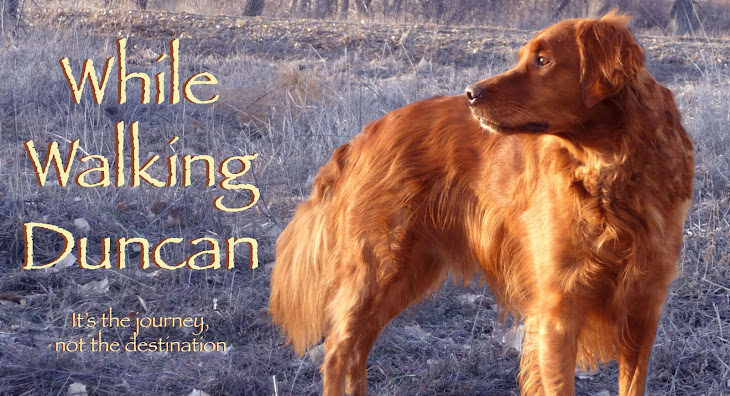
*Photo, as usual, "borrowed" from Google Images
Thursday, August 14, 2008

Lullaby

Let the rain kiss you
Let the rain beat upon your head with silver liquid drops
Let the rain sing you a lullaby
(April Rain Song, Langston Hughes)

It is not an April rain. I'm not sure it's even an August rain. I know it's a big one, though, with lightning and thunder heavier than houses, shaking my own and igniting the dark room where I write. When I glance down I can see my fingers, stark and impossibly white, illuminated in bright staccato bursts above the keyboard. Duncan and Winnie are hovering next to me, one wrapped around my feet, the other huddled up in a tight little ball just to the side of the screen.

We did not walk long tonight. The temperature dropped nearly twenty degrees in the few shorts minutes it took me to change my clothes. It continued to plummet, and a frosty wind picked up while we made our rounds through the park, now overrun with the kiddie soccer leagues and their parents, who pretend to watch from the sidelines but are mostly engaged in gossip with other parents or people over the phone. The first drops, icy and small, started as we rounded the baseball diamonds and picked up in speed and volume as we crossed the fields, which were quickly emptying out. Long lines of SUVs and minivans angled for the exits out of the parking-lots, windshield wipers humming and sweeping rapidly back and forth. By the time we crossed Bowles the rain was driving us down, stinging and cold, as though our entire bodies had fallen asleep like a leg or an arm slept on at the wrong angle. We could not get home fast enough.

I am cold and tired, deserving of quiet and sleep, and the sound of the rain on the windows and in the street outside is its own music. I think I'll turn off the telephone, turn off the lights even, maybe light a few candles and sit in the dark until my eyes grow heavy and Duncan's chin on my ankle no longer shifts with the sound of the thunder but settles in and grows warm against my skin.