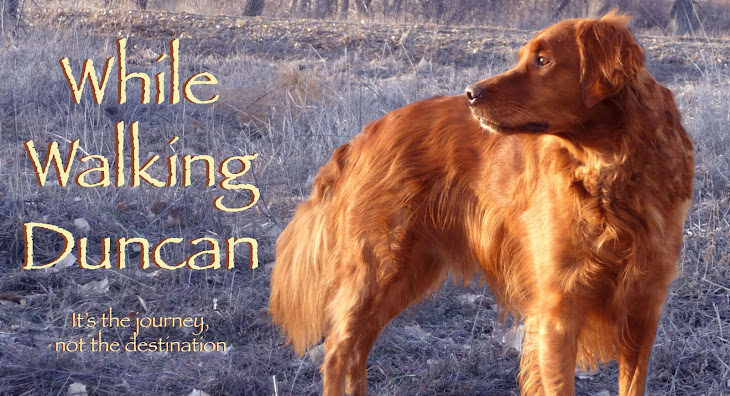
"I see my path, but I don't know where it leads. Not knowing where I'm going is what inspires me to travel it." (Rosalia de Castro)
Funny, the way we set off in a direction with only a vague idea of destination, and eventually, when we're not even looking really, reach that place we didn't quite know existed. One year ago Duncan walked me across the park and led me to that momentary encounter which changed our walks forever. Prior to that they'd been private affairs and most of what occurred remained in my head, only occasionally surfacing in dreams or perhaps journal entries or conversations with Ken; the vast majority, though, are lost, little more than flashes of experience which flit across my sense memory and then fade away again.
Let me tell you.
When I was six and shortly after my mother and sister and I moved from Nampa, Idaho to Pocatello, I remember asking my mother to sit down at our kitchen table and take dictation. There was a story about a monkey and a pig and a walk through the jungle that wasn't going to tell itself and so Mom sat patiently and filled in the words I was unable to commit to paper. She may still have them even now.
By the time I was ten and able to scratch words out on my own, I was the star of creative writing in the fourth grade. Mrs. Coons, an army sergeant of a woman who I feared first and loved later, encouraged my writing, and my voice. That summer I began writing plays which all the kids in the neighborhood performed for our parents in my backyard.
At thirteen I began an epic story, a soap opera really, which I wrote for the next ten years, filling more than twenty enormous volumes. It had an unfortunate title, Love Affair, but to give you some idea of how long it was, if it had been on television and you were to watch one episode a week, thirty weeks of the year, it would take you fourteen years to reach the end.
At twenty-one I awoke from a sound sleep, a voice speaking in my ear, deep and omnipotent––one of those voices you do not ignore, like Kevin Costner's character in "Field of Dreams,"––telling me, "If you go, it will happen." My gut told me I needed to move to Lake Forest, Illinois to study creative writing. And so I did, without much explanation, and with little warning. While there I composed three books, one for each year, made only ten copies and gave them to those friends and family I was closest to. I graduated with many honors from my department and with the aid of my words was fully expected to make something of myself.
And then, by the time I reached thirty, the words seemed to have dried up and left as suddenly as they appeared. One morning not long after my mentor, Phil Simmons––author of Learning to Fall––, had died, I awoke, Ken asleep next to me, to find Phil sitting at the foot of my bed, his hand firmly planted on my calf, shaking me awake.
"Curt," he said in that high-pitched and unsure quivering voice of his. "You are not doing what you are supposed to be doing."
I actually argued with him––which was not an entirely new thing to occur between us––tried to convince him there were more important people he should be sitting with, his wife and two young children that I did not matter, than the words were gone.
"Shut up," he told me. "And listen..." And for the next five minutes I did as he said, never doubting he was really there, awake and as sure of his presence as I was of Ken's, or Winnie, curled up on the pillow where my head had made a nice round, warm impression for her. Phil reminded me that I was a writer and that I was squandering the gift the universe had bestowed on me, that I needed to write because that was what I had always been meant to do. And then he was gone, had slipped from existence, leaving behind a sense of where he'd sat, the warmth of his palm on my leg, the sound of his gravel voice still humming inside my ears. Ken awoke, asked who I'd been talking to, and when I explained, he smiled and pulled me into his arms, not disbelieving my story and told me, "Well then, you should write."
My problem has always been beginnings. They are elusive and I am a perfectionist, and if the words don't hit the right tone, have a perfect rhythm or make the complete and solid sound of a lid sealing a jar, they are no good. Despite having the entirety of my first novel in my head, a novel I know is good, know will be published because Phil told me so, I haven't written it because I've been waiting for the words. And so a year ago I started my first blog, School Daze, which eventually led me to Duncan, who has spent the past year leading me every other place, the most important of which has been back to my words. I have worked hard sharpening my voice and finding confidence in it, rediscovering the joy that can be had in a good story. Walking is a lot like telling a story. There is a place to begin, there is a route which, although not always visible, will lead you, if you persevere, to the place you need to go, or maybe even some place better. Then, last Sunday morning, when I did not expect it and was hardly prepared, I awoke at that place. Words had arranged themselves in a new and surprisingly good order inside my head, and it was only when I jumped out of bed and committed them to paper that I realized I'd been handed the plans to my next journey, which I have been waiting a long time to take. The novel I have waited so patiently to begin writing has finally decided it wants to be written. And so it shall.
I have been faithful and disciplined and there has not been a day since I began this undertaking a year ago that I have not walked Duncan and brought you along for part of it. We will still walk and you are still invited to share it with us, but I must take the new path as well, because, as Phil said, that is what I am meant to do. There are more stories to tell and although Duncan's is far from finished I can no longer tell it every day. It won't be easy; I've fretted over it for a very long time but I wanted to tell you because even this has been part of the journey. From the moment I shared our first walk, I had a plan; I just didn't realize it would come so soon.
Duncan and I will be waiting for you. He is always ready and my legs need to be stretched often. Autumn is nice around these parts and I'd love to tell you all about it. There is a mist out tonight and although most of the sky is clouded, I can see Orion peeking out from behind the clouds. He has had many adventures since last we saw him. Maybe he'll share them with us next time. Whenever that may be. Not too long, I hope.

I shall be telling this with a sigh
Somewhere ages and ages hence:
Two roads diverged in a wood, and I—
I took the one less traveled by,
And that has made all the difference. (Robert Frost)
Somewhere ages and ages hence:
Two roads diverged in a wood, and I—
I took the one less traveled by,
And that has made all the difference. (Robert Frost)
*Photo, as usual, "borrowed" from Google Images

